
Recruitment & Selection Analysis
Understand who enters your recruitment process, who progresses and where talent is being lost.
Representation at application stage tells only part of the story. We analyse recruitment journeys stage by stage to understand patterns in attraction, progression, drop-off and outcomes.
Questions we can help answer
Are applicants representative of the relevant labour market?
Are some groups underrepresented before the process even begins?
Do different groups progress at different rates?
Where are candidates dropping out?
Are patterns concentrated in particular campaigns, roles or assessment stages?
Have outcomes changed over time?
What we do
We examine the recruitment funnel from attraction through sift, assessment, interview, offer and appointment.
Where appropriate, we analyse outcomes by demographic and socio-economic characteristics, compare representation with relevant external populations, examine differences statistically and identify where further investigation is warranted.
We are careful about small samples and uncertainty. A difference is not automatically evidence of bias, but it may tell you where to look.
What you get
A clear picture of your recruitment pipeline, the points where representation changes, areas requiring further investigation and practical recommendations for improving the process.
The cost of doing nothing
You may be spending money attracting a broad range of candidates only to lose them later in the process.
Repeated recruitment, unfilled vacancies, avoidable candidate drop-off and poorly targeted attraction activity all carry a cost.
What might this look like?
Diverse applications, but not diverse appointments
A large employer has invested heavily in widening participation and is pleased to see a diverse applicant pool. However, the diversity of successful candidates remains much lower.
We analyse the recruitment funnel across application, sift, online assessment, interview, offer and appointment.
At application stage, representation broadly reflects the relevant labour market. Progression is also similar through the initial sift. The largest change occurs at interview, where candidates from several socio-economic groups progress at noticeably lower rates.
That does not automatically prove the interview process is unfair. It does, however, identify the stage requiring closer examination.
The organisation can then review interview scoring, assessor guidance, criteria, candidate preparation and consistency between panels rather than spending more money trying to attract applicants it is already reaching.
The value: recruitment investment is redirected from “How do we get more people to apply?” to “What happens to them once they are here?”

Indicative Pricing
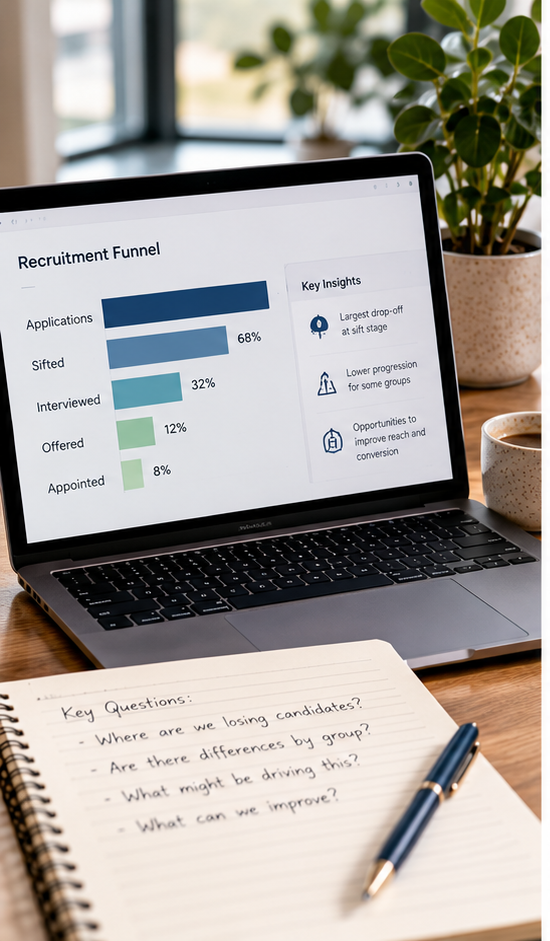
Focused Review
From £1,500
Best for a single campaign, role family or recruitment process where you want to understand where candidates are being lost.
Typically includes application-to-appointment funnel analysis, progression rates by stage, key demographic or socio-economic comparisons, identification of major drop-off points, concise interpretation, and a short findings report with recommendations.
Example: One recruitment campaign, 800 applicants, analysis across application, sift, interview and offer, with a small number of demographic variables.
Full Recruitment & Selection Analysis
Typically £2,500–£4,000
Best for organisations wanting a more detailed view of fairness, representation and progression across a recruitment process.
Typically includes detailed stage-by-stage analysis, representation compared with the relevant labour market where appropriate, demographic and socio-economic progression analysis, statistical testing where justified, examination of campaign or role differences, identification of areas requiring further investigation, and an executive report or presentation.
Example: Several campaigns across one year, 3,000 candidates, multiple candidate characteristics, progression analysis and leadership presentation.

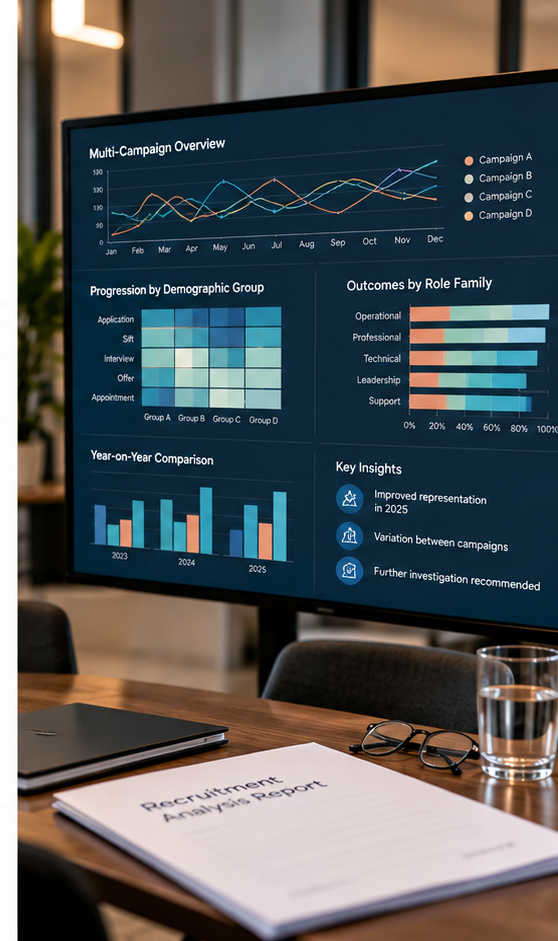
Complex / Multi-Campaign Analysis
From £4,500+
For larger organisations, multiple campaigns or more complex recruitment systems.
Could include several recruitment routes or role families, multi-year trend analysis, larger demographic and socio-economic datasets, campaign comparisons, intersectional analysis where sample sizes allow, labour-market benchmarking, deeper modelling, and stakeholder workshops.
Example: 10,000+ candidate records across multiple campaigns and job families, with historical comparison and a detailed review of where representation changes across the recruitment journey.
Where are you losing people?
We can help you find out.
Pricing depends on the number of recruitment stages, campaigns, candidate records, variables available, benchmarking requirements and the complexity of the analysis. We agree the scope and price before work begins.
Submit an Inquiry
Fill out the form and a member of the team will get back to you.
Alternatively email us at [email protected]